 Solar Energy
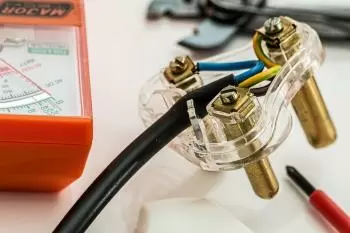
Electric current is the orderly movement of electric charges through a conductor when there is a potential difference between its ends. This flow of electrons allows the transmission of electrical energy and is associated with the generation of electric and magnetic fields.
Depending on how the flow of charge varies over time, electric current is mainly classified into two broad types: direct current (DC) and alternating current (AC).
Direct Current (DC)
Direct current is one in which electric charges always move in the same direction, maintaining a relatively constant intensity over time.
This type of current is characteristic of devices powered by batteries, batteries and electronic systems, as well as of the energy generated by photovoltaic solar energy installations before their conversion.
Alternating Current (AC)
Alternating current is one in which the direction of the flow of electric charge varies periodically over time. In this type of current, the intensity and polarity change cyclically.
It is the type of current used in transmission and distribution power grids, as it allows voltage levels to be easily transformed by transformers, which reduces losses in energy transport.
Types of alternating current
Within alternating current, different forms and classifications can be distinguished depending on its behavior and application.
Sinusoidal current
It is the most common form of alternating current. Its variation over time follows a sinusoidal function, which allows efficient energy transmission and stable behavior in electrical systems.
Quasi-stationary current
This is the name given to an alternating current of sufficiently slow variation so that, at any instant, the laws of direct current can be applied with good approximation, such as Ohm's law and Kirchhoff's laws.
This model is valid for most conventional industrial electrical systems, except in very high frequency applications.
High Frequency Current
It is an alternating current that works at high frequencies (in the order of kilohertz or higher). In this regime, phenomena such as electromagnetic radiation and the film effect become important, which causes the current to tend to concentrate on the surface of the conductor.
Eddy currents
Eddy currents are induced currents that appear inside conductive materials when they are subjected to a variable magnetic field.
These currents form closed circuits within the material itself and generate energy losses in the form of heat, especially in transformer cores and electrical machines.
Single-phase systems
Single-phase current is made up of a single phase of alternating current. In this system, the voltage varies uniformly in a single circuit.
It is mainly used in domestic installations and small electrical loads, such as lighting or low-power appliances.
A typical single-phase installation includes:
- Phase: conductor through which the active current flows.
- Neutral: conductor that allows the current to return.
- Earth: protective conductor that derives possible current leakage to the ground.
Three-phase systems
The three-phase current is made up of three alternating currents of equal frequency and amplitude, 120 degrees of electrical difference from each other.
This system is the standard in generation, transport and distribution of electrical energy, as it offers greater efficiency and stability in transmission.
It is widely used in industry, especially in three-phase electric motors, and in power generation plants, where it facilitates direct connection to the grid.
Measurement of electric current
The electric current intensity is measured in amperes (A) and the ammeter is used as a measuring instrument.
Historical context
The adoption of alternating current over direct current in electrical distribution systems was the result of the so-called "war of currents" at the end of the nineteenth century. In this debate, the alternating current model promoted by Nikola Tesla and George Westinghouse prevailed over the direct current system defended by Thomas Edison, due to its greater efficiency in transport over long distances.