 Solar Energy

Electric charge is a fundamental physical property of matter that determines how particles interact using electromagnetic forces. Thanks to this property, bodies can attract or repel each other and generate electric and magnetic fields.
Electricity, magnetism and a large part of the electromagnetic phenomena that we observe in nature have their origin in the presence and movement of electric charges.
What is an electric charge?
An electric charge is an intrinsic property of certain subatomic particles that allows them to interact through the electromagnetic force.
The unit of electrical charge in the International System of Units (SI) is the coulomb (C). One coulomb is equivalent to the amount of charge carried by a current of one ampere during one second:
where:
-
Q is the electric charge (C).
-
I is the current intensity (A).
-
t is the time(s).
A fundamental characteristic of electric charge is that it is conserved. This means that the total charge of an isolated system remains constant: it cannot be created or destroyed, only transferred from one body to another.
In addition, the electric charge is an invariant quantity, that is, its value does not depend on the observer's state of motion.
Study of electrical phenomena
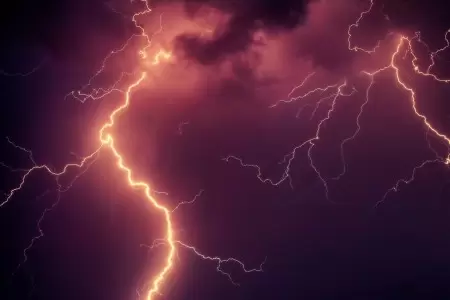
Electrical phenomena are all those physical processes in which electric charges are involved, either at rest or in motion. These phenomena are present in numerous aspects of nature and technology, from lightning during a storm to the operation of modern electronic devices.
The study of electricity is part of electromagnetism, one of the four fundamental interactions of physics. Traditionally, the analysis of electrical phenomena is divided into two major branches: electrostatics and electrodynamics.
Electrostatic
Electrostatics is the branch of physics that studies electric charges at rest and the forces they exert on each other. It focuses on understanding how charges are distributed on bodies and how they generate electric fields around them.
Among the phenomena studied by electrostatics are:
- The attraction and repulsion between charged bodies.
- Electrification by rubbing, contact and induction.
- The distribution of loads in conductors and insulators.
- The behavior of electric fields and electric potential.
- The operation of devices such as capacitors.
Coulomb's law is one of the fundamental principles of this discipline, since it allows the calculation of the electric force between two point charges.
Electrodynamics
Electrodynamics studies the behavior of electric charges when they are in motion. These moving charges give rise to electric currents and generate magnetic fields, establishing a close relationship between electricity and magnetism.
This branch analyzes aspects such as:
- The circulation of electric current in conductors.
- The generation and propagation of electromagnetic fields.
- The interaction between moving charges and magnetic fields.
- Electromagnetic induction.
- The transport and transformation of electrical energy.
Electrodynamics not only explains the operation of electrical currents in conductors, but also modern technologies such as electric motors, generators and photovoltaic solar energy systems, where the movement of electrons allows solar radiation to be converted into electricity.
Today, thanks to Maxwell's equations, it is known that electricity and magnetism are manifestations of the same physical phenomenon: electromagnetism.
Types of electrical charges
There are two fundamental types of electric charge:
Positive charge
It is possessed by protons. A body is positively charged when it has lost electrons and, therefore, has more protons than electrons.
Negative charge
It is possessed by electrons. A body is negatively charged when it has gained electrons and has more electrons than protons.
Charges of the same sign repel each other, while those of the opposite sign attract.
The Elementary Electric Charge
The elemental charge is the minimum unit of electrical charge observed in isolation in nature. It corresponds to the absolute value of the charge of an electron or a proton:
Therefore, the electric charge of any macroscopic object is always an integer multiple of this quantity.
Are there smaller loads?
Quarks possess fractional charges equivalent to ±1/3 or ±2/3 of the elementary charge. However, due to the phenomenon of confinement, they are never observed in isolation, but in the form of composite particles such as protons and neutrons.
The electron
The electron is a subatomic particle with a negative charge and an approximate rest mass of:
Its mass is about 1,836 times less than that of the proton.
In atoms, electrons occupy so-called orbital regions around the atomic nucleus and are primarily responsible for electrical and chemical phenomena.
The proton
The proton is a positively charged subatomic particle that, together with neutrons, forms the nucleus of atoms.
The number of protons in an atom determines its atomic number (Z), which identifies each chemical element in the periodic table.
Protons are extremely stable particles and play a fundamental role in the structure of matter.
Coulomb's Law and Electrostatic Forces
Coulomb's law describes the electric force between two point charges:
This law establishes that:
-
The force is directly proportional to the product of the loads.
-
The force decreases with the square of the distance that separates them.
-
Charges of the same sign repel each other.
-
Charges of opposite sign attract.
Electric and magnetic fields
Electric charges generate an electric field around them, regardless of whether they are at rest or in motion.
When charges move forming an electric current, they also generate a magnetic field. The interaction between electric and magnetic fields forms the basis of electromagnetism.
In addition, a charge moving within a magnetic field experiences a force called the Lorentz force, which is essential for the operation of electric motors, generators and numerous technological devices.
Voltage and Charge Storage
As a charge is added to a conductor, the energy required to incorporate additional charges increases due to the electrostatic repulsion between them.
This energy per unit load is called the electric potential or voltage and is measured in volts (V).
Electrical capacitors
Capacitors are devices designed to store electrical energy. They are made up of two conductors separated by an insulating material and take advantage of the attraction between opposite charges to accumulate energy.
They are used in electronic circuits, power supplies, filtering systems, and temporary energy storage.
Cargo storage in conductors
Electrical charge can also be stored in insulated conductors, such as a metal sphere. The capacity to store cargo depends on its size, geometric shape and the environment that surrounds it.
This property is known as capacitance and is one of the fundamental concepts of electronics and electrical engineering.