 Solar Energy

Direct current is a type of electric current in which electric charges move through a conductor while always maintaining the same direction of circulation. It is also known as direct current (DC).
In electrical diagrams, direct current is usually represented by the symbol DC or by a solid line accompanied by dashed lines (— — —), while alternating current is identified by the symbol AC or by a sine wave (~).
The flow of current can occur through different material means, such as metallic conductors, semiconductors and even vacuum, as occurs in electronic devices such as old cathode ray tubes.
In direct current circuits, the conventional direction of the current is established from the positive pole to the negative pole, although in reality the electrons move in the opposite direction, from the negative pole to the positive pole.
Direct current is naturally present in technologies such as photovoltaics, which generate electricity directly in this format.
Characteristics of direct current
In direct current, the flow of electrical charge always maintains the same direction. According to convention, it circulates from the positive pole to the negative pole, although in reality the electrons move in the opposite direction.
It can spread through different media, such as metal conductors, semiconductors, and even vacuum, as occurs in certain electronic devices.
Historical origin and evolution
The first practical applications of electricity were based on direct current, especially in the networks developed by Thomas Edison in the late nineteenth century. However, over time, alternating current became more popular in electrical transmission and distribution due to its greater efficiency in transporting over long distances and the ease of transforming voltages.
Today, direct current has regained a central role in modern electronics and energy conversion technologies.
Direct Current Sources
Direct current can be obtained from a variety of sources:
- Chemical reactions, such as in batteries, which remain the most common form of DC generation in portable devices.
- Direct current electric generators, based on the principle of dynamo, capable of converting mechanical energy into electrical energy.
- Photovoltaic solar energy systems, which generate electricity directly in the form of direct current before its possible conversion to alternating current by inverters.
Uses of direct current
Direct current is particularly suitable for electronic devices and low-voltage applications, where a stable and controlled supply of power is required.
Some common examples are:
- Photovoltaic systems, where the energy generated in DC is subsequently converted into AC by inverters for use in the electricity grid.
- Batteries, such as those in flashlights or portable devices.
- Electronic systems such as mobile phones, computers and communication devices.
- Electric vehicles and modern railway traction systems.
- Small household appliances and electronic equipment, which internally operate in direct current even though they are powered by the electricity grid.
In practice, although the domestic power grid supplies alternating current, most electronic devices internally transform this energy into direct current via power supplies.
Conversion between alternating current and direct current
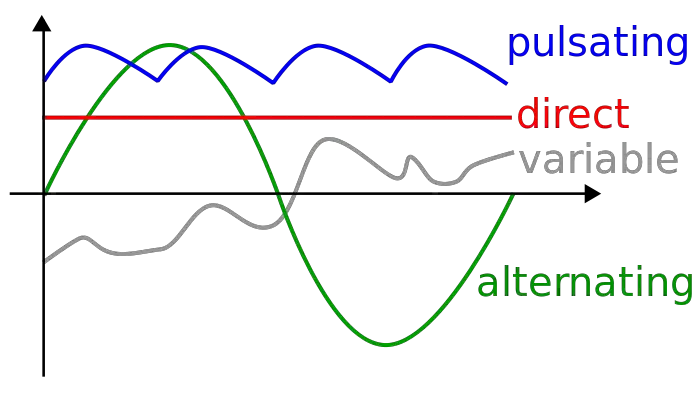 The conversion from alternating current (AC) to direct current (DC) is carried out through rectification processes. This process is carried out using rectifier diodes or bridges, which eliminate the alternation of the direction of the current and allow a unidirectional signal to be obtained.
However, this rectified signal is not perfectly constant, but pulsating. To smooth it out and bring it closer to a stable direct current, filters are used, usually made up of capacitors, which reduce voltage variations.
In contrast, reverse conversion, from direct current to alternating current, requires more complex devices called inverters, widely used in renewable energy systems and power electronics.