 Solar Energy

A solar thermal power plant, also known as a solar thermal or photothermal power plant, is an industrial facility designed to take advantage of solar radiation and transform it into electrical energy.
Although its operating principle is similar to that of conventional thermal power plants, it differs in one fundamental aspect: the heat source used is not of fossil origin, but is based on solar energy.
How does a solar thermal power plant work?
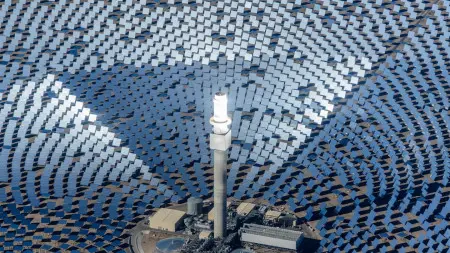
This type of photothermal technology consists of capturing solar radiation and converting it into thermal energy, which is then used in an electricity generation process.
To do this, the installation concentrates solar radiation through a system of mirrors or reflectors that direct the energy towards a specific point. This heat is transferred to a thermal fluid – usually water, thermal oil or molten salts – which can reach very high temperatures, usually between 300 °C and more than 1,000 °C, depending on the technology used.
Once heated, this fluid is used to produce high-pressure water vapor. The steam generated drives a turbine connected to an electric generator, which transforms mechanical energy into electricity. In general, the higher the temperature reached, the higher the performance of the system.
Solar Concentration Systems
The capture and concentration of solar radiation is carried out by means of adjustable mirrors that automatically follow the path of the sun to maximise energy use.
Among the main concentration systems used in photothermal or solar thermal power plants are:
- Heliostats with a central tower: a field of mirrors reflects solar radiation to a receiver located at the top of a tower. A heliostat is each of these individual mirrors that carry a mechanized system of tracking the sun
- Parabolic trough collectors: curved mirrors concentrate the radiation on a receiver tube through which the thermal fluid circulates.
- Parabolic disks: parabolic geometry systems that concentrate solar radiation at a focal point.
Thermodynamic cycles in a solar thermal power plant
Once the heat is captured, the plant uses different thermodynamic cycles to convert thermal energy into electricity.
The most common is the Rankine cycle, based on the generation of steam to move a turbine, similar to that used in conventional thermal power plants. There are also systems that employ the Brayton cycle, especially in hybrid configurations, as well as experimental technologies such as the Stirling engine.
In some cases, photothermal power plants can be combined with other energy sources, such as natural gas, with the aim of improving efficiency and ensuring electricity production when solar radiation is lower.
Efficiency of a thermoelectric power plant
Solar thermal power plants that concentrate sunlight to produce electricity do not take advantage of all the energy they receive. Its efficiency depends on several important factors:
- The technology used to transform solar energy into electricity.
- The temperature at which the heat-collecting system works.
- The heat losses that occur during the process.
- Other losses inherent to the operation of the installation.
To all this we must add that the optical system that concentrates sunlight (mirrors or disks) is not perfect either, so part of the energy is also lost.
What efficiency can be achieved?
Depending on the type of technology, the efficiency values change:
- Solar tower plants, which operate at temperatures between 250 and 565 °C, can achieve maximum efficiencies of between 23% and 35%. When combined with combined-cycle turbines, they can further improve their performance.
- Stirling disc systems, which operate at higher temperatures (550 to 750 °C), can reach an efficiency of approximately 30%. You can learn more in this article from the U.S. Department of Energy .- Dish Engine
Real efficiency in everyday life
Although these values may seem high, in practice the actual efficiency is lower. This is because the amount of sunlight changes throughout the day and year.
As a result, the average annual efficiency is typically between 7% and 20% in solar tower systems and between 12% and 25% in Stirling disk systems.
Environmental effects
Solar thermal power plants are not exempt from environmental impacts. Below are some of the environmental effects of solar thermal power plants:
- Land use: Solar thermal power plants, especially those using parabolic trough or parabolic dish technology, require large areas of land to house solar reflectors. This can result in the conversion of natural habitats into industrial areas. In some regions, the installation of plants on high-quality agricultural land can displace the production of food and harvestable plants.
- Impact on wildlife: Solar thermal power plants can attract insects, birds, and other animals due to the heat generated by the reflectors. This can increase the risk of collisions and injuries to surrounding wildlife, which has led to the implementation of mitigation measures, such as bird deterrent systems.
- Water consumption: Some plants require water for cooling and operating systems. Water consumption can be significant, and in water-scarce regions, this raises concerns about the availability of this vital resource.
- Conversion efficiency: The conversion efficiency of solar energy into electricity in solar thermal power plants can vary and, in some cases, is lower than that of other solar energy technologies, such as solar photovoltaic panels.
- Visual and Landscape Impact: Solar thermal power plants, especially those with large fields of mirrors or reflectors, can change the local landscape and have a significant visual impact on the surrounding areas.
Main solar thermal power plants in the world
Below, we present a selection of some of the most outstanding solar thermal power plants in the world, highlighting their location, electricity production capacity and a brief description of their key characteristics.
| Solar thermal power plant | Location | Electricity production (MW) | Description |
|---|---|---|---|
| Ivanpah Solar Electric | California, USA | 392 MW | The Ivanpah plant is one of the largest solar thermal power plants in the world, which uses solar tower technology with heliostat mirrors to concentrate sunlight on three towers. It is located in the Mojave Desert and provides electricity to thousands of homes. |
| Solana Generating Station | Arizona, USA | 280 MW | Solana is one of the largest plants of its kind in the world and uses parabolic trough collector technology with molten salt heat storage. It provides electricity to Arizona's power grid. |
| Crescent Dunes Solar Energy Center | Nevada, USA | 110 MW | This plant uses solar tower technology with molten salts as a thermal storage medium. It is one of the first plants of its kind with large-scale energy storage. |
| Shouhang Dunhuang Solar Thermal Power Plant | China | 100 MW | This plant uses parabolic trough collectors to generate electricity and also has molten salt thermal storage. It is an important project for the development of solar energy in China. |
| Solar Gem | Seville, Spain | 19.9 MW | Gemasolar is a solar tower plant with molten salt storage that stands out for its ability to generate electricity 24 hours a day. It is an example of innovation in solar energy storage technology. |
Terminological clarification: solar thermal, solar thermal and photothermal power plant
Although they are often used synonymously, solar thermal power plant, solar thermal power plant and photothermal energy present some nuances of meaning.
The term solar thermal power plant refers to an industrial facility that takes advantage of solar radiation to generate heat and transform it into electrical energy.
When we talk about a solar thermal power plant, we usually refer to that same type of plant. It is the most common term in the energy and technical field.
Photothermal energy describes the process by which solar radiation is converted into thermal energy. In other words, it refers to the technology or the energy principle, rather than to the installation itself.