 Solar Energy

The first law of thermodynamics states that:
"The total energy of an isolated system is neither created nor destroyed; it only transforms from one form to another."
Although this definition may seem abstract or technical, it is constantly reflected in everyday phenomena and in various technological applications. To better understand it, we will analyze some practical examples.
In all these cases, let's remember that heat, energy and work are measured in Joules (J) according to the International System of Units.
1. Conserving energy in a ball thrown into the air
When a child throws a ball into the air, two main types of energy are involved: kinetic and gravitational potential.
-
When it leaves the child's hands, the ball has kinetic energy due to its speed. At this instant, its potential energy is minimal because it has not yet reached height.
-
As it climbs, the speed decreases and gains height: kinetic energy is transformed into potential energy.
-
At the highest point, the ball has only potential energy.
-
As it descends, the potential energy is transformed back into kinetic energy, accelerating toward the ground.
In this process, the total energy of the system (balloon + Earth) remains constant, as long as we ignore losses due to friction with the air.
2. Steam engines
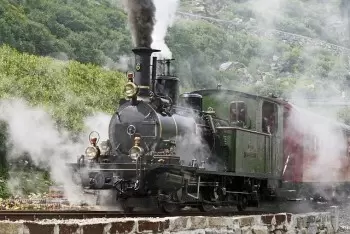
Let's consider a steam locomotive:
-
The initial energy comes from the fuel (coal), which stores chemical energy.
-
When the coal is burned, this chemical energy is converted into thermal energy, heating the water in the boiler.
-
The steam generated drives the pistons, transforming the thermal energy into mechanical energy.
-
The locomotive acquires kinetic energy as it moves.
However, the system is not completely isolated; There are losses:
-
Smoke and steam escaping into the environment.
-
Friction between pistons and wheels, and with the track.
-
Heat loss to the surrounding air.
This example illustrates that energy does not disappear, but is dissipated or transformed into less useful forms, fulfilling the first law.
3. Solar energy: photovoltaic and thermal
The Sun is a constant source of energy. Its atoms contain internal energy, released through nuclear fusion reactions, which generate solar radiation.
When this radiation reaches Earth:
-
Photovoltaic solar panels convert some of that energy into electricity.
-
Solar thermal panels transform energy into heat for water or heating.
However, the yield is never 100%:
-
Some of the energy is lost in the form of waste heat.
-
Another part is reflected or dispersed in the atmosphere.
Even so, the total energy is still conserved, complying with the first law.
4. A refrigerator
A refrigerator does not create cold, but transports heat from the inside to the outside using a thermodynamic cycle:
-
The refrigerant absorbs heat from inside the freezer, lowering the internal temperature (thermal energy transferred).
-
The compressor performs mechanical work on the refrigerant, allowing heat to be expelled to the outside environment.
The electrical energy consumed is transformed into mechanical work and heat.
No energy disappears; it is only redistributed, complying with the first law.
5. A moving car
In a moving car, energy is continuously transformed:
-
The chemical energy in the fuel is converted into heat energy when it burns in the engine.
-
This thermal energy is transformed into mechanical energy that moves the wheels.
-
Friction and friction convert part of that energy into heat, which is dissipated into the environment.
Again, the total energy is conserved, even if it is distributed in different ways.