 Solar Energy

Thermodynamics is a fundamental branch of physics that studies the relationships between heat, work, and energy. Its development has been key to understanding how everything from steam engines to modern energy systems work.
Far from arising from a single discovery, thermodynamics is the result of more than a century of scientific advances, driven by both theoretical curiosity and industrial needs.
1. The origins: the Industrial Revolution
The birth of thermodynamics is closely linked to the Industrial Revolution (18th and 19th centuries), when steam engines became the engine of the economy.
At the time, engineers were looking to improve the performance of these machines, but there was no scientific theory to explain how they worked. Heat was understood as an invisible substance called caloric, which flowed from one body to another.
2. Sadi Carnot and the Birth of Thermodynamics (1824)
The first great advance came with Nicolas Léonard Sadi Carnot, considered the father of thermodynamics.
In 1824 he published his work Reflections on the Motive Power of Fire, where he analysed how thermal engines work. Carnot arrived at two fundamental ideas:
-
There is a maximum limit of efficiency in any heat engine.
-
Performance depends on the temperature difference between hot and cold sources.
To explain this, he proposed the Carnot cycle, an ideal model that describes the most efficient engine operation possible.
Although Carnot still believed in the caloric theory, his work laid the foundation for all subsequent thermodynamics.
3. The end of caloric theory
In the mid-nineteenth century, several experiments showed that heat was not a substance, but a form of energy.
Benjamin Thompson (Earl of Rumford)
He observed that drilling cannons generated heat in a seemingly unlimited way, which contradicted the idea of caloric.
James Prescott Joule
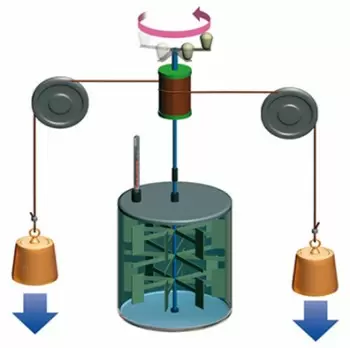
His most famous experiment involved stirring a liquid using paddles moved by falling weights. The result was an increase in temperature proportional to the work performed.
Bottom line: Heat is a form of energy, not a substance.
4. The First Law of Thermodynamics
These discoveries led to the formulation of the First Law of Thermodynamics, which states:
Energy is neither created nor destroyed, it is only transformed.
This law was developed by several scientists:
-
Julius Robert von Mayer (1841): formulated the principle of conservation of energy.
-
James Joule (1843): provided the experimental basis.
-
Hermann von Helmholtz (1847): generalized the principle to all physics.
-
Rudolf Clausius (1850): gave a rigorous mathematical formulation.
This principle introduced the concept of internal energy, key to describing the state of systems.
5. The Second Law and the Concept of Entropy
The First Law explains the conservation of energy, but it does not indicate in which direction the processes occur. This limitation led to the development of the Second Law of Thermodynamics.
Rudolf Clausius and Lord Kelvin
These scientists formulated the Second Law, which states that:
-
Heat flows naturally from hot to cold bodies.
-
It is not possible to convert all heat into work without losses.
Clausius introduced the concept of entropy, a magnitude that measures the degree of disorder in a system.
Key idea: Natural processes tend to increase entropy.
This explains why many processes are irreversible, such as heat diffusion or friction.
6. Statistical mechanics: Maxwell and Boltzmann
At the end of the nineteenth century, thermodynamics took a conceptual leap with the appearance of statistical mechanics.
-
James Clerk Maxwell and Ludwig Boltzmann explained the laws of thermodynamics from the behavior of millions of particles.
-
Entropy came to be interpreted in terms of probability.
This made it possible to connect the microscopic world (atoms and molecules) with the macroscopic world (temperature, pressure, energy).
7. The Third Law of Thermodynamics
In the twentieth century, physicist Walther Nernst formulated the Third Law, which states that:
-
As it approaches absolute zero, the entropy of a system tends to a constant minimum value.
This law is fundamental in physics and chemistry, especially in the study of materials and reactions at low temperatures.
8. Modern Applications
Today, thermodynamics is essential in multiple fields:
-
Engineering: engines, turbines, cooling
-
Energy: thermal power plants, solar energy
-
Chemistry: Chemical Reactions and Equilibrium
-
Physics: From Classical Systems to Black Holes
Even concepts like entropy have applications in areas like computer science and information theory.