 Solar Energy

The measurement of solar radiation makes it possible to evaluate the solar resource available in a location, to size photovoltaic installations and to analyze the energy performance of systems already installed. To do this, different instruments are used to measure the different components of the radiation that reaches the Earth's surface.
In addition, in some cases sunshine is also measured, i.e. the effective duration of solar radiation. Traditionally, this value is obtained by means of sunlight hour recorders, which record the presence of effective sun when the irradiance exceeds approximately 120 W/m².
Types of solar radiation measured
Solar radiation is broken down into different components depending on its origin and behaviour in the atmosphere. Each requires specific measurement methods.
Direct radiation (DNI)
Direct radiation corresponds to Direct Normal Irradiance (DNI), which is radiation that arrives directly from the Sun without having been scattered by the atmosphere. It is measured on a surface perpendicular to the sun's rays.
This type of radiation is especially relevant in concentrating solar technologies (CSP) and in advanced studies of the solar resource.
Global (GHI) and diffuse radiation

Diffuse radiation, on the other hand, is the part of solar radiation that has been scattered by the atmosphere before reaching the ground, especially in cloudy or aerosol conditions.
Infrared (longwave) radiation
Infrared or longwave radiation does not come directly from the Sun for the most part, but from the atmosphere and the Earth's surface, which emit thermal energy after absorbing solar radiation.
This component is part of the energy balance of the Earth-atmosphere system and is key in climate studies.
Instruments for measuring solar radiation
The measurement of solar radiation is carried out using specific instruments that allow each component to be quantified precisely. The choice of equipment depends on the type of radiation and the level of accuracy required.
Pyrheliometer: direct radiation measurement (DNI)
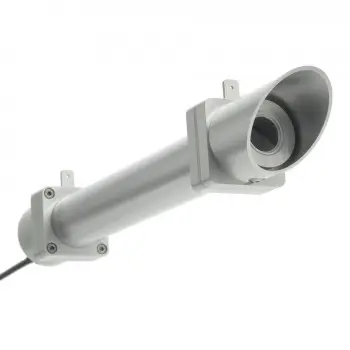
To get accurate measurements, it should be installed in a solar tracking system that keeps it aligned with the Sun throughout the day, as any angular deviation can affect the reading.
It is mainly used in reference stations, climate research and concentrating solar plants (CSP), where direct radiation is the key parameter.
Pyranometer: global and diffuse radiation measurement
The pyranometer is the most widely used instrument in photovoltaic energy. It measures global horizontal radiation (GHI), i.e. the sum of direct and diffuse radiation on a horizontal surface.
It works by means of thermal sensors or photodiodes protected by a glass dome, which guarantees a uniform response regardless of the angle of incidence of radiation.
Using shading systems, it can also measure only diffuse radiation, allowing the solar radiation balance to be broken down.
This instrument is essential for estimating the energy production of photovoltaic installations and validating their real performance.
Pyrgeometer: Infrared radiation measurement
The pyrgeometer measures long-wave infrared radiation emitted by the atmosphere and the Earth's surface.
It does not measure direct solar radiation, but the heat exchange between the Earth and its environment, which is why it is used in energy balance and climatology studies.
These sensors filter out shortwave radiation to focus exclusively on infrared radiation, usually above 4 μm.
Ultraviolet (UV) radiation sensors
Ultraviolet radiation sensors measure the intensity of UV radiation from the Sun, especially in the UV-A and UV-B bands.
Although they do not directly influence PV production, their measurement is important for analyzing material degradation, solar module aging, and environmental sun exposure.
These sensors use photodiodes and optical filters that isolate ultraviolet radiation from the rest of the solar spectrum.
Solar Radiometers
Solar radiometers are portable instruments designed to measure irradiance in real time quickly.
They are mainly used in technical inspections, verification of photovoltaic installations and preliminary studies of the solar resource at a location.
Although they do not reach the accuracy of reference instruments, they provide reliable results for operational applications. Some models include digital connectivity, data logging, and automatic temperature compensation.
Solar Metering Stations
In professional applications, these instruments are often integrated into solar weather stations, which combine pyranometers, pyrheliometers, and environmental sensors.
These stations allow a complete view of the solar resource to be obtained and the design and operation of photovoltaic installations to be optimised.