 Solar Energy

Every time we turn on a light, charge our mobile phone or use an appliance, we are taking advantage of a technology that revolutionised modern society: alternating current.
Today it seems like an everyday occurrence, but during the nineteenth century there was an intense scientific and business race to find the best way to generate and distribute electricity. That competition, starring some of the greatest inventors in history, would end up defining the electrical system we still use today.
The first steps towards electricity generation
The history of alternating current begins long before modern power grids existed.
In 1831, British physicist Michael Faraday made one of the most important discoveries in science: electromagnetic induction. He showed that a moving magnetic field could generate an electric current in a conductor.
This principle made it possible to convert mechanical energy into electricity and laid the foundation for the development of electric generators, transformers, and motors.
Just a year later, the French inventor Hippolyte Pixii built one of the first electric generators based on this discovery. Although the technology was still very rudimentary, that advance opened the door to a new energy era.
The initial dominance of direct current
For much of the 19th century, direct current (DC) was the predominant technology for electrical distribution.
Direct current always circulates in a single direction, something that simplified its use in the first electrical systems. Its main promoter was Thomas Alva Edison, who developed electricity supply networks in cities such as New York.
However, this system had an important limitation: electricity lost much of its energy over long distances. As a result, power plants had to be built in close proximity to consumers, making it extremely expensive to expand the networks.
As cities grew and energy demand increased, this problem became increasingly apparent.
The arrival of alternating current
While Edison was betting on direct current, several European engineers were working on a different solution.
Inventors such as Zenobe Gramme, Lucien Gaulard, and John Dixon Gibbs made major advances in the development of generators and transformers capable of working with alternating current.
The great advantage of this system was that it allowed the voltage to be easily modified by means of transformers. In this way, electricity could be transported at very high voltages – reducing energy losses – and then reduced to safe levels for consumption.
That characteristic would change the electricity industry forever.
Nikola Tesla and the Alternating Current Revolution
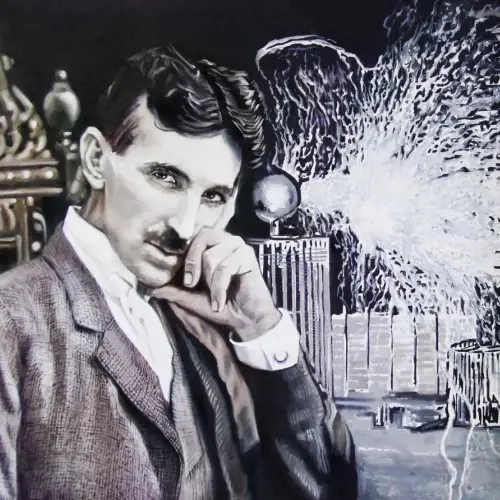 The real definitive impulse came from the hand of Nikola Tesla.
After working briefly for Edison, Tesla developed a complete system based on alternating current that included generators, transformers, and induction motors.
In 1887 he presented one of his greatest achievements: the alternating current induction motor, a much more efficient and reliable technology than many of the existing alternatives.
Tesla understood that alternating current not only made it possible to transmit electricity over long distances, but also offered enormous advantages for industry and automation.
Its patents caught the attention of businessman George Westinghouse, who acquired the exploitation rights and began to develop electrical networks based on this system.
The War of the Currents
The rivalry between Edison and Tesla, backed by Westinghouse, gave rise to one of the most famous episodes in the history of technology: the so-called War of the Currents.
Edison advocated direct current, while Tesla and Westinghouse advocated alternating current.
For years, both sides fought an intense commercial and media battle to convince governments, companies and citizens of what the most appropriate technology was.
Although Edison tried to discredit alternating current by arguing that it was more dangerous, the technical and economic advantages of this system ended up prevailing.
The ability to transport energy over long distances with minimal losses proved decisive.
The project that changed history
The moment that confirmed the superiority of alternating current came in the 1890s.
Westinghouse won contracts to electrify large facilities and, especially, to develop the hydroelectric development of Niagara Falls.
The Niagara Power Plant became a practical demonstration that alternating current could generate electricity on a large scale and transport it tens of kilometers away efficiently.
From that point on, the adoption of alternating current accelerated around the world.
The fundamental role of transformers
The success of alternating current would not have been possible without another key innovation: transformers.
These devices allow the voltage to be raised during the transport of electricity and subsequently reduced for safe use in homes, businesses and industries.
Thanks to this system, energy can travel hundreds of kilometers with relatively low losses, something that was practically impossible with the direct current networks of the time.
This feature remains one of the foundations of the modern electrical system.
Why do we still use alternating current?
 More than a century later, alternating current continues to be the predominant form of electrical distribution in practically the entire world.
Its main advantages are:
-
Lower energy losses during transport.
-
Ease of transforming voltage levels.
-
Cheaper infrastructures for large electricity grids.
-
High reliability in industrial and domestic applications.
Although direct current has now regained prominence in specific applications such as solar panels, batteries, electric vehicles or very high voltage transmission links, conventional electrical distribution is still mostly based on alternating current.
A discovery that transformed society
The history of alternating current is much more than a succession of inventions and patents. It represents one of the most influential technological advances in modern history.
From Faraday's experiments to Tesla and Westinghouse's innovations, the development of alternating current made possible the electrification of entire cities, fueled industrialization, and laid the foundation for the connected world we live in today.
More than a hundred years after the War of the Currents, the system that was born to solve an electrical transmission problem continues to power homes, factories and millions of devices around the planet.